Free Morse Code Translator — Convert Text, Audio & Images Online
Instantly translate text to Morse code and back — with audio playback, image OCR decoding, and live mic detection. Perfect for ham radio operators, students, and anyone learning ITU Morse code or SOS signals.
Translate Morse Code Instantly — Text, Audio and Image in One Tool
Most morse code tools do one thing. This one does everything.
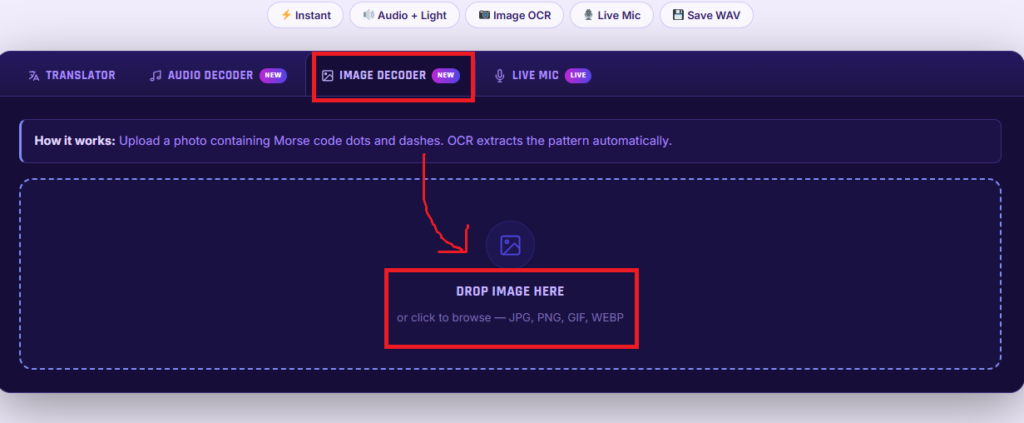
Type any word and watch it convert to dots and dashes before you lift a finger. Paste a morse code string and get clean English text back in under a second. Upload an audio file or an image containing morse code. The tool reads both and returns the decoded message.
You stay in one place the whole time.
The translator runs on the International Morse Code standard published by the ITU (International Telecommunication Union) as ITU-R M.1677-1. Every letter from A to Z follows the exact dot-dash sequences that radio operators and HAM enthusiasts worldwide use. All common punctuation marks and numbers in morse code are fully supported — from 0 to 9 — each with their own unique five-signal pattern.
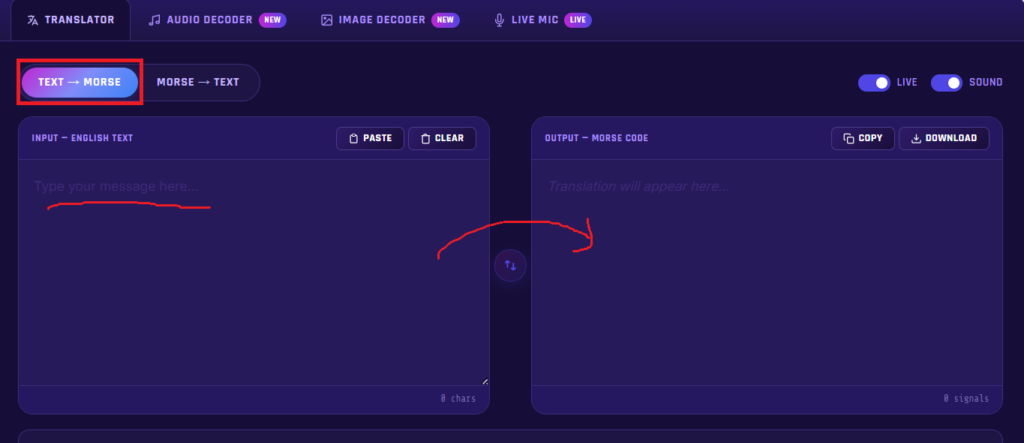
Text to Morse Code
Type any sentence in English. The tool encodes it in real time using the correct ITU dit-dah sequences. See the output update with every keystroke.
Morse Code to English
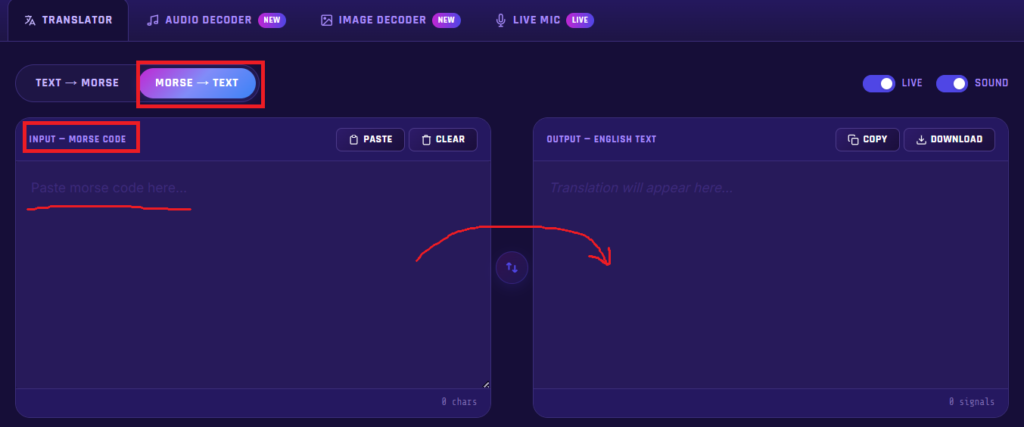
Paste any morse string. Use dots (.) for dits and dashes (-) for dahs. Separate letters with a single space. Separate words with a forward slash (/) or a double space. The decoder returns accurate English text instantly.
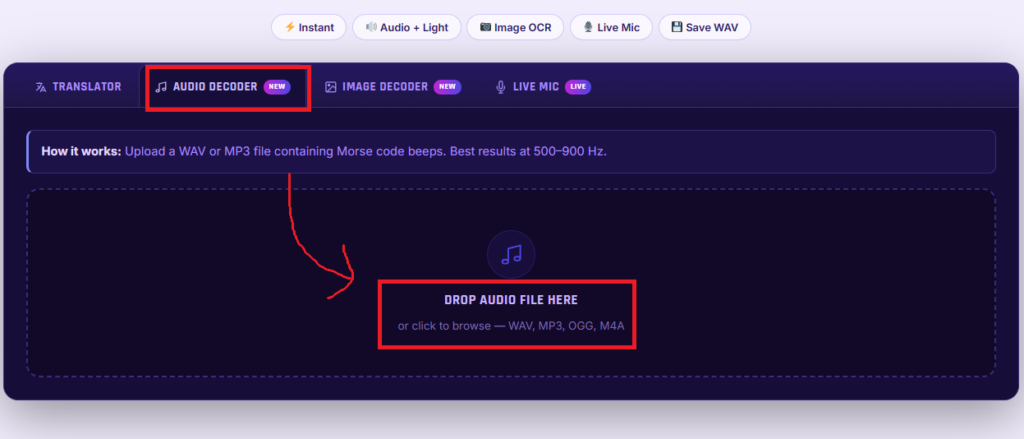
Audio and Image Decoding
Upload a WAV, MP3, or audio file recorded from a telegraph key, radio receiver, or any CW (continuous wave) source. Or upload a photo of morse code written on paper. The tool extracts and decodes the message from both.
No account needed. No data stored. Works on every browser, phone, and device.
How to Use Our Morse Code Translator in 3 Easy Steps
You do not need to know morse code to use this tool. You do not need any technical background either.
Three steps. That is all it takes.
Step 1 — Enter Your Text or Morse Code
Click the input box on the left. Type your message in plain English. The tool starts converting the moment you begin typing. No submit button. No waiting.
Switching to decode mode? Click “Morse to Text” at the top. Paste your morse string into the input box. Use dots and dashes separated by spaces.
Step 2 — Choose Your Translation Direction
Select “Text to Morse” to encode English into dots and dashes. Select “Morse to Text” to decode a morse string back into English. Hit the swap arrow between the two boxes to flip directions instantly. Your content moves with it.
Step 3 — Copy, Download, Listen or Share Your Result
Your output is ready the moment you stop typing. Four things you can do with it:
That is the full process. From text to morse code and back again in seconds.
Key Features of Our Morse Code Translator Tool
This is not a basic text box with a convert button. Every feature was built to save time, give accurate results, and handle more than plain text.
Feature | What It Does |
Real-Time Conversion | Translates as you type, zero delay |
Bidirectional Translation | Text to Morse and Morse to Text in one tool |
Audio Playback | Plays your morse code as actual sound tones |
Adjustable WPM | Control speed from 5 to 40 words per minute |
Pitch Control | Set audio frequency between 300 Hz and 900 Hz |
Light Signal Indicator | Visual LED flashes in sync with the morse pattern |
WAV Export | Download your morse audio as a WAV file |
Image Decoder | Upload a photo and extract morse code using OCR |
Audio File Decoder | Upload a WAV or MP3 and decode the tone pattern |
Live Mic Detection | Decode morse in real time through your microphone |
ITU Standard Compliant | Follows ITU-R M.1677-1 for all characters |
Zero Data Storage | Nothing you type is saved, sent, or tracked |
Mobile Friendly | Works on any screen size, any browser |
Audio Playback with WPM and Pitch Control
The audio engine uses the Web Audio API to generate clean sine wave tones. The WPM setting follows standard Farnsworth timing — a dot lasts 1,200 milliseconds divided by your chosen WPM. Every dash is exactly three times the length of a dot. HAM radio operators and amateur radio learners who want to go beyond playback can use our morse code audio translator to decode real recorded signals from WAV and MP3 files.
Image OCR Decoder
Upload any image containing morse code as text symbols. The tool uses Tesseract OCR to scan the image, extract the dot-dash characters, and decode them to plain text. Works on screenshots, handwritten notes, and printed telegraph transcripts.
Live Microphone Decoder
Allow microphone access and play morse code tones near your device. The tool detects the tone pattern using frequency analysis and builds the decoded message live. The waveform visualizer shows your audio input in real time.
Morse Code Alphabet, Letters and Numbers — Complete Reference Chart
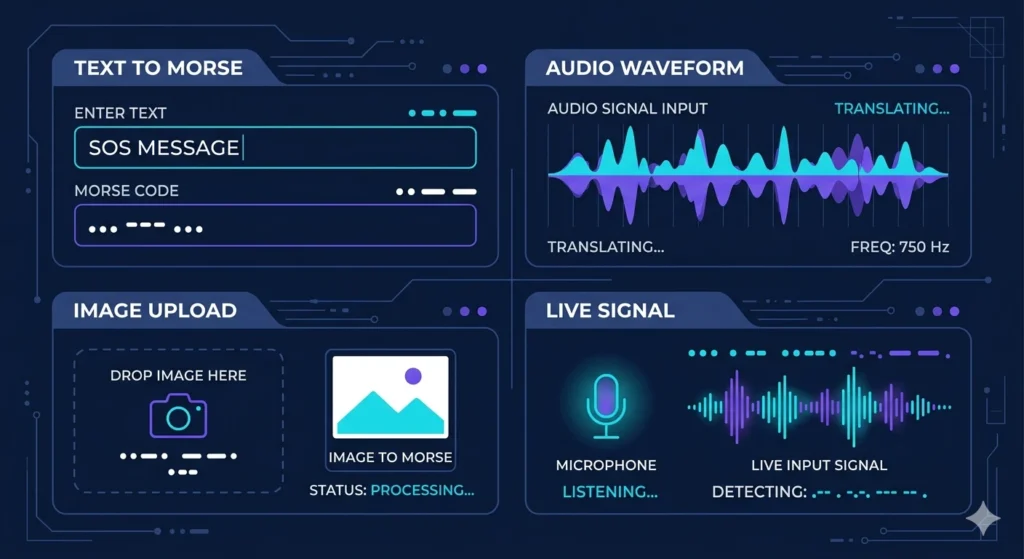
Samuel Morse and Alfred Vail developed morse code in the 1830s alongside the electric telegraph. The ITU later standardized it into the full morse code alphabet we use today. Every character has a fixed dot-dash pattern.
Letters A to Z
Letter | Morse | Letter | Morse |
A | . — | N | — . |
B | — . . . | O | — — — |
C | — . — . | P | . — — . |
D | — . . | Q | — — . — |
E | . | R | . — . |
F | . . — . | S | . . . |
G | — — . | T | — |
H | . . . . | U | . . — |
I | . . | V | . . . — |
J | . — — — | W | . — — |
K | — . — | X | — . . — |
L | . — . . | Y | — . — — |
M | — — | Z | — — . . |
These 26 letter codes are the foundation of every morse code message ever sent. If you want to convert English to morse code right now without memorizing this chart, our free converter does it for you instantly.
Numbers 0 to 9
Number | Morse | Number | Morse |
0 | — — — — — | 5 | . . . . . |
1 | . — — — — | 6 | — . . . . |
2 | . . — — — | 7 | — — . . . |
3 | . . . — — | 8 | — — — . . |
4 | . . . . — | 9 | — — — — . |
Common Punctuation
Symbol | Morse | Symbol | Morse |
. period | . — . — . — | , comma | — — . . — — |
? question | . . — — . . | / slash | — . . — . |
@ at sign | . — — . — . | = equals | — . . . — |
How to Read the Patterns
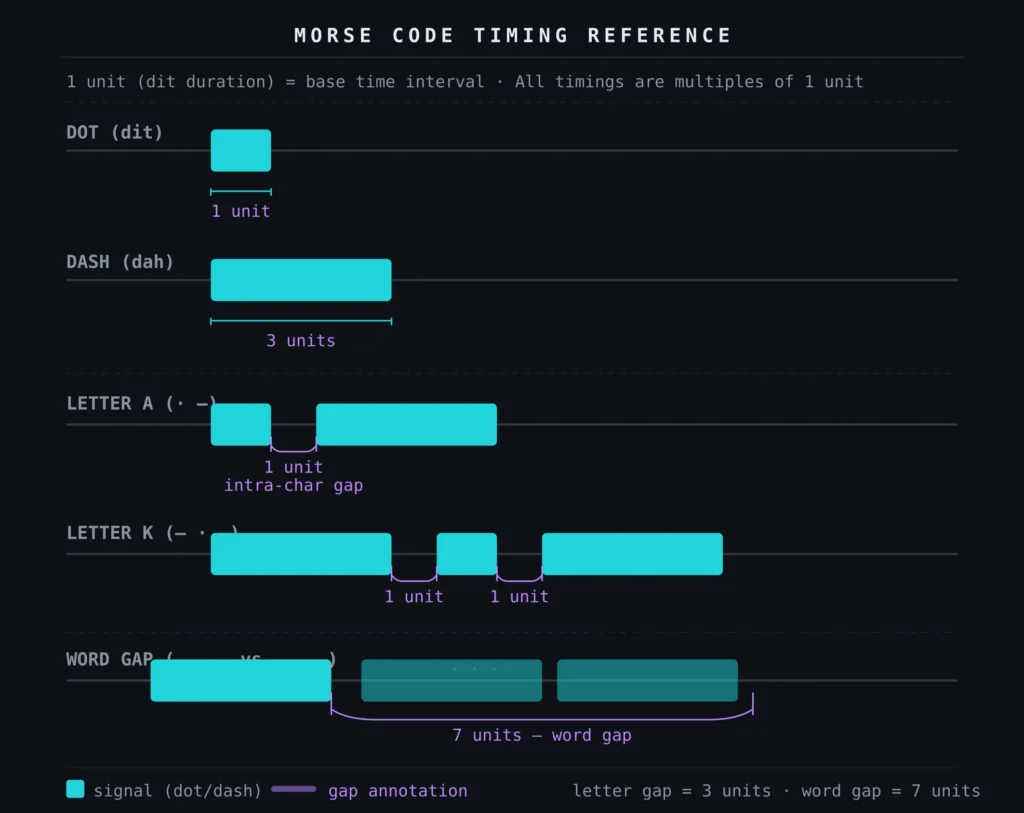
Each dot (.) is a short signal called a dit. Each dash (—) is a long signal called a dah. A dah lasts exactly three times as long as a dit. Timing rules for live transmission:
Professional HAM radio operators do not memorize charts. They learn to hear patterns as sounds. E is a single dit. T is a single dah. S sounds like dit-dit-dit. O sounds like dah-dah-dah. Start with the shortest codes and build from there.
SOS Morse Code — The Universal Distress Signal (. . . — — — . . .)
Three dots. Three dashes. Three dots.
That sequence is one of the most recognized signals in human history. It crosses every language barrier. It works without a voice. It has saved lives at sea, in the air, and in remote wilderness where no other communication was possible.
SOS does not stand for anything. The pattern was chosen in 1908 at the Berlin Radiotelegraphic Convention because it was impossible to confuse with any other sequence.
The SOS Pattern
Signal | Morse Pattern | Timing |
S | . . . | Three dits |
O | — — — | Three dahs |
S | . . . | Three dits |
Full SOS | . . . — — — . . . | Sent as one continuous block |
SOS is sent as a single unbroken prosign. No gaps between S, O, and S. The entire sequence flows as one unit. This is what separates SOS from three separate letters in standard transmission.
Where SOS Is Still Used Today
Context | How SOS Appears |
Maritime emergencies | Transmitted via radio or signal lamp |
Aviation distress | Backup signal for downed aircraft |
Wilderness survival | Tapped on surfaces or flashed with a torch |
Military training | Part of SERE (Survival, Evasion, Resistance, Escape) training |
Smartphone accessibility | iPhone and Android emergency tap patterns |
How to Signal SOS Without a Radio
Flash a torch three short, three long, three short. Tap a hard surface with a rock. Blow a whistle in the same pattern. Arrange rocks on open ground in three groups. Rescuers in search and rescue operations are trained to recognize all of these.
Use the Play with Light feature on the translator above to see the exact SOS flash pattern before you need it in the field.

The Most Common Morse Code Phrases and Translations
People use morse code for personal messages, jewelry engravings, tattoos, and creative projects. These are the most searched phrases.
Everyday Greetings
Phrase | Morse Code |
. . . . / . / . — . . / . — . . / — — — | |
Hi | . . . . / . . |
Emotional and Personal Phrases
Phrase | Morse Code |
. . / . — . . / — — — / . — . . / — — — / . — . . / . . — / . — — — / — — — / . . — | |
I miss you | . . / — — / . . . / . . / — . — — / — — — / . . — |
Be safe | — . . . / . / — — — — — / . . . / . — / — — — — . / . |
Popular Short Codes
Phrase | Morse | Meaning |
. . . — — — . . . | Universal distress signal | |
OK | — — — / — . — | Acknowledged |
Yes | — . — — / . / . . . | Affirmative |
No | — . / — — — | Negative |
Help | . . . . / . / . — . . / . — — . | Request assistance |
Morse Code for Special Occasions
People engrave morse code on rings, bracelets, and pendants. The message stays hidden until the recipient learns to decode it.
Occasion | Phrase | Morse Code |
Wedding | Always | . — / . — . . / . — . . / . — . — — . — — . — . . |
Birthday | Happy birthday | . . . . / . — / . — — . / . — — . / — . — — |
Memorial | Forever | — — — — . / — — — / — . — . / . — . . |
Use the translator above to convert any phrase. Copy the output. Use it however you want.
How to Read and Write Morse Code
Reading morse code is a skill. Writing it is a process. Both get easier the moment you understand the system behind the dots and dashes.
The Decoding Process — Reading Morse Code
Every morse code message is built from three building blocks. A dot. A dash. A space. That is the entire system.
Work left to right, one character group at a time. Each group of dots and dashes separated by a space is one letter. Each group of letters separated by a slash is one word.
Start with the shortest, most common letters:
Letter | Code | Why It Is Easy |
E | . | Single dot — shortest code in the system |
T | — | Single dash — second shortest |
I | . . | Two dots |
A | . — | Dot then dash |
N | — . | Dash then dot |
M | — — | Two dashes |
These six letters appear in roughly 45 percent of all written English text. Learn them first and you can read most common words immediately.
The Encoding Process — Writing Morse Code
Wrong spacing turns a readable message into gibberish. The gaps carry as much meaning as the dots and dashes themselves.
Timing and Spacing Rules
Element | Duration |
Dit (dot) | 1 unit |
Dah (dash) | 3 units |
Gap between symbols in one letter | 1 unit |
Gap between letters in one word | 3 units |
Gap between words | 7 units |
Morse Code Sounds — Hearing the Dots and Dashes
Professional operators never say dot and dash. They say dit and dah. The letter C sounds like dah-dit-dah-dit. The letter Q sounds like dah-dah-dit-dah. This verbal system is the foundation of the Koch method — one of the most effective techniques for learning morse code by ear.
Learn Morse Code Step by Step
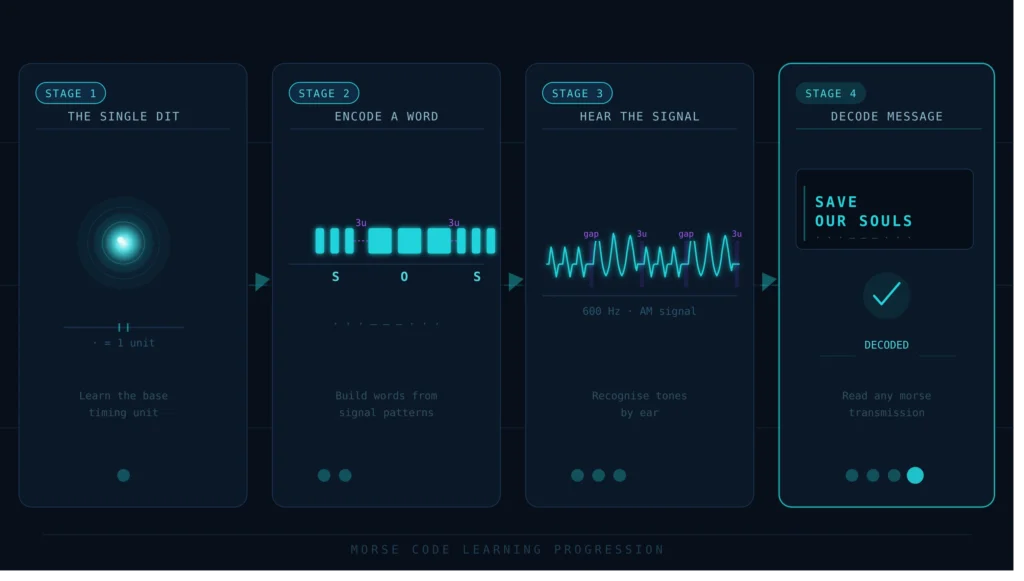
Most people give up on morse code because they start wrong. They open a chart, try to memorize all 26 letters at once, and feel overwhelmed within the first hour.
Morse code is learned the same way you learned to read. One sound at a time. Repeated until it becomes automatic.
Step 1 — Start With E and T
E is a single dit. T is a single dah. Every other letter branches from these two in the ITU code tree. Spend ten minutes listening to E and T through the audio tool. Do not look at the screen. Just listen.
Step 2 — Build Short Words
Stage | Letters | Practice Words |
Stage 1 | E, T | — |
Stage 2 | I, A, N, M | MINE, MEAN, ITEM |
Stage 3 | S, O, R | MORE, ONES, SOME |
Stage 4 | H, D, L | HOLD, SHED, LOAD |
Stage 5 | C, U, F | CLUE, FUEL, CUFF |
Stage 6 | P, G, W | GROW, WRAP, GLOW |
Stage 7 | B, V, K | BACK, KNOB, VERB |
Stage 8 | J, X, Q, Z | JAZZ, ZEAL, QUIZ |
Move to the next stage only when you can decode without looking at a chart.
Step 3 — Use Farnsworth Timing
The Farnsworth method plays each letter at full speed but extends gaps between letters. Your brain hears the letter as a complete sound while the spacing gives you time to process it.
Setting | Value | Why |
WPM | 15 to 20 | Fast enough to learn sounds not symbols |
Pitch | 550 to 700 Hz | Closest to real telegraph tones |
Volume | 60 to 70 | Comfortable for long practice sessions |
Step 4 — Decode Real Messages Daily
Type a short sentence into the translator. Convert it to morse. Play the audio and try to copy what you hear without looking at the output. Ten minutes every single day beats one hour on weekends for building pattern recognition.
How Long Does It Take?
Level | Description | Approximate Time |
Basic | Decode 5 to 10 letters by ear | 1 to 2 weeks |
Copy short words at 5 WPM | 3 to 4 weeks | |
Intermediate | Copy sentences at 10 to 13 WPM | 2 to 3 months |
Learn Morse Code with Sound — Songs, Beats and Audio Practice
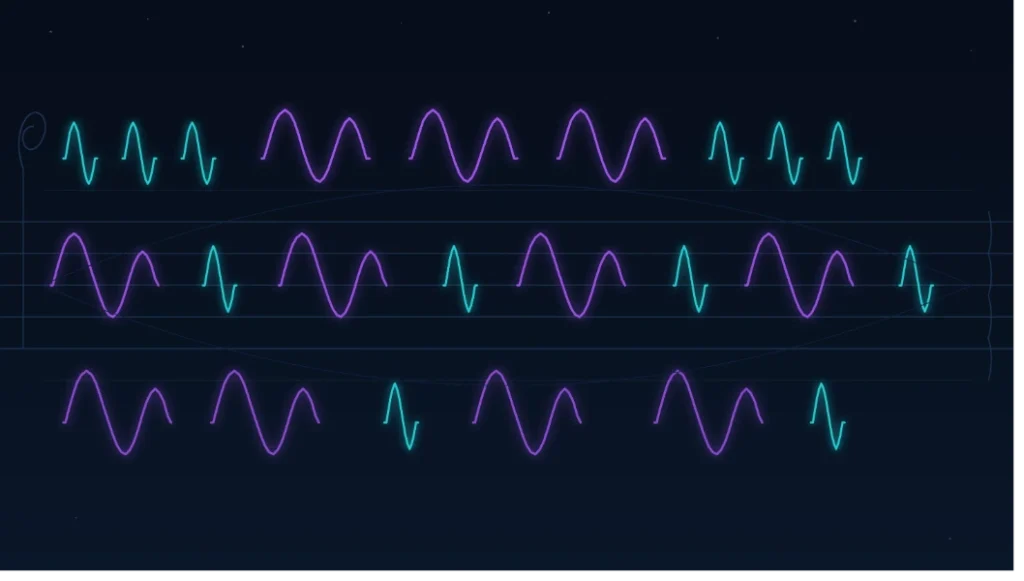
Professional radio operators never forget morse code once they learn it properly. They stopped thinking of it as a visual pattern and started hearing it as music.
Every letter has a rhythm. Your brain is already wired to recognize rhythmic patterns. You use that same ability when you recognize a song from its first two notes.
The Melody of Dots and Dashes
Letter | Morse | Vocal Sound | Rhythm |
C | — . — . | dah-dit-dah-dit | “COPY that” |
F | . . — . | dit-dit-dah-dit | “Not so FAST” |
Q | — — . — | dah-dah-dit-dah | “God SAVE the Queen” |
V | . . . — | dit-dit-dit-dah | Beethoven’s Fifth Symphony |
The letter V is the most famous example. Beethoven’s Fifth Symphony opens with dit-dit-dit-dah. The BBC used it as their call signal during World War II broadcasts because of this connection. Once you attach a rhythm phrase to a letter your brain retrieves the code instantly.
Farnsworth Practice Schedule
Week | WPM | Pitch | Duration | Focus |
Week 1 | 15 | 600 Hz | 10 min | Single letters |
Week 2 | 18 | 600 Hz | 10 min | Short words |
Week 3 | 20 | 650 Hz | 15 min | Five letter words |
Week 4 | 20 | 700 Hz | 15 min | Short sentences |
Month 2 | 25 | 700 Hz | 20 min | Copied text |
Never slow down to fix a mistake. Let the Farnsworth gaps carry you through difficult letters.
Pitch Range Guide
Pitch | Effect |
300 to 450 Hz | Deep, harder to distinguish short patterns |
500 to 700 Hz | Optimal range for pattern recognition |
750 to 900 Hz | Sharp but fatiguing over long sessions |
Use the pitch slider on the translator to find what feels natural to you.
Modern Uses of Morse Code Today
Morse code never disappeared.
Industry | How It Is Used Today |
Amateur Radio (HAM) | CW bands remain among the most active worldwide |
Aviation | VOR and NDB beacons transmit identifiers in morse |
Military | Backup communication in electronic warfare environments |
Emergency Services | GMDSS recognizes morse SOS as a valid distress call |
Accessibility | Switch devices use morse for motor-disabled users |
Education | STEM programs use morse to teach binary logic |
Gaming | Escape rooms and ARGs embed morse codes as clues |
Personal Expression | Tattoos, engravings, and art installations |
Amateur Radio and HAM Communication
The CW sub-bands sit at the bottom of every amateur radio frequency allocation. A 5 watt CW signal travels further than a 100 watt voice transmission in many conditions. This efficiency keeps morse relevant for DX (long distance) contacts and low power QRP operating.
Aviation Navigation
Every VOR (VHF Omnidirectional Range) and NDB (Non-Directional Beacon) station transmits its three-letter identifier in morse continuously. Pilots cross-check navigation instruments by listening for these identifiers. This system has operated without interruption since the mid-20th century.
Accessibility and Assistive Communication
People with ALS, cerebral palsy, and spinal cord injuries use morse as an alternative input method. A single switch allows input through any controlled movement — an eye blink, a breath, a finger twitch. Google integrated morse code directly into Gboard for Android, making the full alphabet accessible through just two keys.
STEM Education
Teachers use morse code to introduce binary logic, signal encoding, and information theory. The on-off nature of morse transmission is a direct physical demonstration of how digital communication works at its most basic level. Dots and dashes are 1s and 0s with sound attached.
The History of Morse Code — From Telegraph to Digital Age
Morse code is nearly 200 years old. It remains in active use today. That alone makes it one of the most durable communication systems ever created.
Samuel Morse and the Invention
Samuel Finley Breese Morse was an American painter, not an engineer. He began developing his idea for an electric telegraph in 1832 aboard a ship from Europe. His collaborator Alfred Vail contributed the critical refinements — assigning the shortest codes to the most frequent letters. E became a single dit. T became a single dah.
On May 24, 1844, Morse sent the first official telegraph message from the US Capitol to a railway station in Baltimore — a moment that makes far more sense once you understand how was Morse code invented through years of grief, collaboration, and experimentation. The message read: “What hath God wrought.” That single transmission changed the speed of human communication forever.
Milestone | Year | Significance |
Morse develops telegraph concept | 1832 | First idea formed aboard a ship |
First public telegraph line | 1844 | Washington D.C. to Baltimore |
Transatlantic telegraph cable | 1866 | Europe and North America connected |
International Morse Code adopted | 1865 | ITU standardizes the system |
SOS adopted as distress signal | 1908 | Berlin Radiotelegraphic Convention |
ITU removes morse requirement | 1999 | HAM licensing no longer mandates morse |
Google Gboard morse input | 2018 | Morse integrated into mobile keyboards |
How the Telegraph Changed the World
Before the telegraph, news traveled at the speed of a horse. The telegraph collapsed that delay to minutes. Stock prices, military orders, and personal messages moved at the speed of electricity for the first time. Western Union built an entire commercial empire on telegraph infrastructure. By 1880 there were over 650,000 kilometers of telegraph wire crossing North America alone.
The telephone replaced the telegraph. Radio replaced the telephone. The internet replaced both. Morse code survived every transition because it is efficient, requires minimal bandwidth, and works with the simplest possible equipment.
That resilience is why the military still trains operators in morse. It is why HAM operators fill the CW bands every day. It is why a 19th century system now lives inside a smartphone keyboard used by millions.
Who Uses Our Morse Code Translator?
User Group | Why They Use It |
|---|---|
Students and Educators | STEM lessons, school projects, coding fundamentals |
HAM Radio Operators | Practice CW, verify callsigns, decode received signals |
Outdoor Enthusiasts | Emergency signaling for hiking, camping, sailing |
Puzzle Solvers and Gamers | Escape rooms, ARGs, adventure game clues |
Couples and Friends | Personal messages, jewelry engravings, tattoos |
Accessibility Users | Alternative input for motor-impaired individuals |
History Enthusiasts | Telegraph era research, military communications |
Students and Educators
Morse code makes abstract concepts tangible. Binary logic, signal timing, and encoding become visible when students convert text to dots and dashes. No additional software or equipment needed.
HAM Radio Operators
CW operators verify letter codes, practice copying speed, and decode unfamiliar prosigns. History researchers transcribe telegraph documents and military communications from World War I and World War II.
Outdoor Enthusiasts and Survivalists
Knowing SOS and basic distress signals is practical safety knowledge. Search and rescue teams, wilderness guides, and sailors keep morse code in their toolkit alongside PLBs (personal locator beacons) and VHF radios.
Couples and Personal Use
Ring engravings, friendship bracelets, tattoos, and handwritten notes encoded in dots and dashes. The message is private by default. Only the person who knows to look for it will ever find it.
Why Choose Our Morse Code Translator?
Dozens of morse code tools exist online. Most do one thing adequately. This one does everything accurately — from decoding and translating to working as a full online morse code generator with audio, image, and live mic support.
Feature | Our Tool | Most Competitors |
Real-time translation | Yes | Yes |
Audio playback | Yes | Some |
Adjustable WPM and pitch | Yes | Rarely |
WAV file export | Yes | No |
Image OCR decoder | Yes | No |
Audio file decoder | Yes | No |
Live microphone input | Yes | No |
Light signal visualizer | Yes | No |
ITU-R M.1677-1 compliant | Yes | Unclear |
Zero data storage | Yes | Unclear |
No login required | Yes | Yes |
ITU Standard Compliant
Every character follows ITU-R M.1677-1. The same standard used by HAM operators, maritime services, and aviation navigation systems worldwide.
Your Text Is Never Stored
Nothing you type leaves your browser. No server logs. No tracking. No data collection. Your message stays between you and your screen.
No Subscriptions, No Paywalls
Every feature is completely free. Audio playback, WAV export, image decoding, live microphone detection, and the full reference chart. No account. No limits.
One tool. Every feature. Always free.